
Proyecto de Negocio
CIDEM-113 (JM-20) Novel multifunctional neuroprotective agent for the treatment of Parkinson's disease (PD)
Therapeutic Area :
Neurology
Project Description:
Parkinson’s disease (PD) is a long-term degenerative disorder of the central nervous system that primarily affects the motor system. There is currently no cure for PD, but treatments are available to help relieve symptoms and maintain quality of life. PD affects more than one million people in the U.S. and 10 million worldwide. In the European Union, the prevalence is similar to that of the United States, being approximately 1.2 million people, and its incidence is expected to triple by 2050. In the United States, the economic burden of PD is at least USD 14.4 billion per year, with USD 8.1 billion in medical expenses and USD 6.3 billion in indirect costs attributed to the disease.
It is important to note that although there are some treatment alternatives, there is currently no effective medical alternative available and no specific diagnostic test, thus making this disease a complex and sometimes lengthy process.
CIDEM-113, also known as JM-20, is a small, hybrid molecular chemical entity with multiple cellular and subcellular targets. CIDEM-113 was designed and developed by the Center for Pharmaceutical Research and Development (CIDEM) and the University of Havana in Cuba. The CIDEM-113 project is currently completing the preclinical phase to initiate clinical development.
Main Results in Preclinical Studies:
Preclinical studies support the potential of CIDEM-113 for the treatment of PD. In vitro studies conducted over the past few years show that CIDEM-113:
- Protects brain mitochondria from calcium-induced deterioration.
- Alters H-ATPase activity and consequently reduces vesicular uptake of glutamate.
- Inhibits the formation of neurotoxic alpha-synuclein aggregates.
CIDEM-113 was also evaluated in different animal models of Parkinson’s disease, showing the following results:
- Reduced oxidative stress and improved mitochondrial functions, survival and motor activity in rotenone-damaged rats.
- It was found to prevent motor damage after unilateral administration of 6 OHDA in rats.
- CIDEM-113 classified as a non-toxic compound after being safe in genotoxic, acute toxicity and repeated dose toxicity studies in rats.
- With a logP of 3.9, CIDEM-113 is classified as a highly lipophilic molecule which allows it to cross the blood-brain barrier.
Intellectual Property :
Benzodiazepine derivative with activity in the central nervous and vascular systems. CU 2016/0058. PCT/CU2017/050002; WO/2017/190713
| GRANTED | IN PROCEDURES | ||
| Country | Concession No. | Country | Patent Application No. |
| Indonesia | 0000784 | Canada | 3.023.105 |
| Mexico | 385439 | Korea | 10-2018-7035040 |
| United States | 11098039 | Japan | 2019-510748 |
| China | ZL201780041572.6 | Brazil | 11 2018 072588 9 |
| Switzerland | 3470414 | New Zealand | 748959 |
| Germany | 60 2017 047 551.3 | Malaysia | PI 2018704116 |
| Denmark | 3470414 | South Africa | 2018 / 08162 |
| Spain | 3470414 | ||
| France | 3470414 | ||
| United Kingdom | 3470414 | ||
| Italy | 3470414 | ||
| Sweden | 3470414 | ||
| Slovenia | 3470414 | ||
| Turkiye | 2022 000303 | ||
| Macao | J/005585 | ||
| Singapore | 11201809845T | ||
| Hong Kong | 40005140 | ||
| Armenia | 201892461 | ||
| Belarus | 201892461 | ||
| Kyrgyzstan | 201892461 | ||
| Kazakhstan | 201892461 | ||
| Russian Fed. | 201892461 | ||
Competitive Advantages :
Considering the multifactorial nature of PD, CIDEM-113 is a potential neuroprotective compound against this disease, having different competitive advantages due to its ability to inhibit glutamate-mediated excitotoxicity, increased calcium influx, mitochondrial dysfunction, different pro-apoptotic pathways, cytotoxic alpha-synuclein aggregation and reactive oxygen species production. All these properties qualify CIDEM-113 as a first-in-class compound.
Business Proposal :
Corporate alliances are required to develop collaboration and/or business modalities, such as:
- Licensing and/or co-development agreements.
- International Economic Partnership: Start-up Joint Ventures or Special Purpose Companies.
Main publications :
- Nuñez-Figueredo et al., JM-20, a novel benzodiazepine–dihydropyridine hybrid molecule, protects mitochondria and prevents ischemic insult-mediated neural cell death in vitro. European Journal of Pharmacology (2014), 726:57–65.
- Nuñez-Figueredo et al., Antioxidant effects of JM-20 on rat brain mitochondria and synaptosomes: Mitoprotection against Ca2+-induced mitochondrial impairment. Brain Res. Bull. (2014), 109: 68-76.
- Nuñez-Figueredo et al., The effects of JM-20 on the glutamatergic system in synaptic vesicles, synaptosomes and neural cells cultured from rat brain. Neurochemistry Int (2015), 81: 41–47.
- Fonseca-Fonseca et al., JM-20, a novel hybrid molecule, protects against rotenone-induced neurotoxicity in experimental model of Parkinson’s disease. Neurosc lett (2019), 690, 29-35.
- Fonseca-Fonseca, L.A., et al., JM-20 protects against 6-hydroxydopamine-induced neurotoxicity in models of Parkinson’s disease: Mitochondrial protection and antioxidant properties. Neurotoxicology, 2021. 82: p. 89-98.
- Santos CC, et al. JM-20, a Benzodiazepine-Dihydropyridine Hybrid Molecule, Inhibits the Formation of Alpha-Synuclein-Aggregated Species. Neurotox Res. 2022 Dec;40(6):2135-2147.
Contact Details :
Name: PhD. Alejandro Saúl Padrón Yaquis
Position: General Director
E-mail address: alejandro.padron@cidem.cu
Phone numbers: +53 7215-2192 / +53 7881-0818
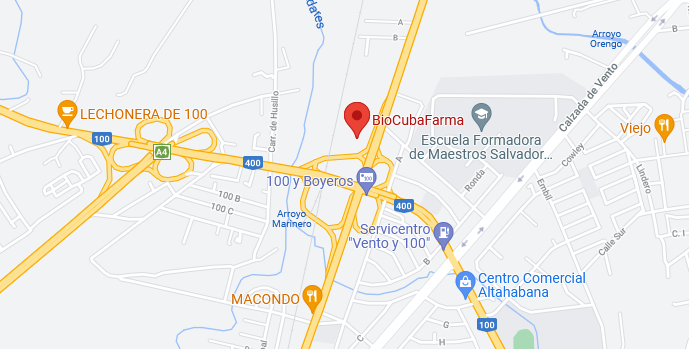
Address: Ave 26 No. 1605 e / Calzada de Boyeros y Calzada de Puentes Grandes, Plaza de la Revolución. Habana-Cuba.
Web site: www.cidem.cu
Copyright © 2023 CIDEM