
Proyecto de Negocio
CIDEM-112 (JM-20) Nuevo agente neuroprotector multifuncional para el tratamiento de la enfermedad de Alzheimer (EA) y otros tipos de demencias
Therapeutic Area :
Neurology
Project Description:
AD is the most common form of dementia and accounts for approximately 60% to 80% of cases, followed by vascular dementias. According to WHO, 50 million people are living with dementia worldwide and 82 million are expected by 2030. The estimated annual incidence is 9.9 million new cases. A recent meta-analysis reported that the overall prevalence of dementia is between 5 and 7 percent among people aged 60 years and older. The cost of treating this disease varies by region, with the overall per capita cost in developed countries ranging from US$30,122 to US$48,605.
The key factors driving the growth of this market are: the rapid aging of the population, investment in biomarkers for drug development, the continued further development of sophisticated drugs and diagnostics for early detection, along with the development of more precise drugs and new emerging diagnostic technologies.
Currently, there is no treatment that can stop this disease, but better policies can improve the lives of people with dementia by helping them and their families adjust to living with the disease and ensuring they have access to affordable, high-quality medical and social care.
CIDEM-112, also known as JM-20, is a small hybrid molecular chemical entity with multiple cellular and subcellular targets. This molecule was designed and developed by the Center for Pharmaceutical Research and Development (CIDEM) and the University of Havana in Cuba. The CIDEM-112 project is currently completing the preclinical phase to initiate clinical development.
Main Results in Preclinical Studies:
Preclinical studies support the potential of CIDEM-112 for the treatment of different types of dementias including AD. CIDEM-112 was evaluated in different animal models of dementia and Alzheimer’s disease, showing the following results:
- In the scopolamine-induced cholinergic dysfunction model, CIDEM-112 ameliorated cognitive deterioration and showed antioxidant and mitoprotective properties.
- In the model of memory impairment induced by aluminum trichloride, CIDEM-112 prevented and reversed the impairment of different types of memory. Mitochondrial protection and modulation of the anti-apoptotic cell signaling pathway were observed.
- Against administration of Aβ oligomers (1-42), CIDEM-112 showed cognitive protection on memory.
- In the animal model of streptozotocin-induced dementia, CIDEM-112 prevented cognitive decline in mice, improved mitochondrial functionality and decreased the oxidative stress associated with this model.
- CIDEM-112 interacts directly with the enzyme acetylcholinesterase, another important molecular target for the treatment of Alzheimer’s disease.
- CIDEM-112 inhibits V-ATPase showing anti-excitotoxic properties.
- CIDEM-112 is classified as a non-toxic compound after being safe in genotoxic, acute toxicity and repeated dose toxicity studies in rats.
- With a logP of 3.9, CIDEM-112 is classified as a highly lipophilic molecule, which allows it to cross the blood-brain barrier.
Intellectual Property :
Benzodiazepine derivative with activity in the central nervous and vascular systems. CU 2016/0058. PCT/CU2017/050002; WO/2017/190713
| GRANTED | IN PROCESS | ||
| Country | No. Concession | Country | No. Patent Application |
| Indonesia | 0000784 | Eurasia | 202291381 |
| Mexico | 385439 | Canada | 3.023.105 |
| United States | 11098039 | Korea | 10-2018-7035040 |
| China | ZL201780041572.6 | Japan | 2019-510748 |
| Switzerland | 3470414 | Brazil | 11 2018 072588 9 |
| Germany | 60 2017 047 551.3 | New Zealand | 748959 |
| Denmark | 3470414 | Malaysia | PI 2018704116 |
| Spain | 3470414 | South Africa | 2018 / 08162 |
| France | 3470414 | ||
| France | 3470414 | ||
| Italy | 3470414 | ||
| Sweden | 3470414 | ||
| Slovenia | 3470414 | ||
| Turkey | 2022 000303 | ||
| Macao | J/005585 | ||
| Singapore | 11201809845T | ||
| Hong Kong | 40005140 | ||
Competitive Advantages :
Considering the multifactorial nature of AD, CIDEM-112 is a potential neuroprotective compound against this disease, having different competitive advantages due to its ability to inhibit acetylcholinesterase activity, glutamate-mediated excitotoxicity, mitochondrial dysfunction, different pro-apoptotic pathways, reactive oxygen species production and calcium fluence. All these properties qualify CIDEM-112 as a first-in-class compound.
Business Proposal :
Corporate alliances are required to develop collaboration and/or business modalities, such as:
- Licensing and/or co-development agreements.
- International Economic Partnership: Start-up Joint Ventures or Special Purpose Companies.
Main publications :
- D’Avila da Silva F, Nogara PA, Ochoa-Rodríguez E, Nuñez-Figueredo Y, Wong-Guerra M, Rosemberg DB, Rocha JBTD. Molecular docking and in vitro evaluation of a new hybrid molecule (JM-20) on cholinesterase activity from different sources. Biochimie. 2020 Jan;168:297-306.
- Wong-Guerra M, Jiménez-Martin J, Fonseca-Fonseca LA, Ramírez-Sánchez J, Montano-Peguero Y, Rocha JB, D Avila F, de Assis AM, Souza DO, Pardo-Andreu GL, Del Valle RM, Lopez GA, Martínez OV, García NM, Mondelo-Rodríguez A, Padrón-Yaquis AS, Nuñez-Figueredo Y. JM-20 protects memory acquisition and consolidation on scopolamine model of cognitive impairment. Neurol Res. 2019 May;41(5):385-398.
- Nuñez-Figueredo Y, Pardo Andreu GL, Oliveira Loureiro S, Ganzella M, Ramírez-Sánchez J, Ochoa-Rodríguez E, Verdecia-Reyes Y, Delgado-Hernández R, Souza DO. The effects of JM-20 on the glutamatergic system in synaptic vesicles, synaptosomes and neural cells cultured from rat brain. Neurochem Int. 2015;81:41-7.
- Nuñez-Figueredo Y, Pardo-Andreu GL, Ramírez-Sánchez J, Delgado-Hernández R, Ochoa-Rodríguez E, Verdecia-Reyes Y, Naal Z, Muller AP, Portela LV, Souza DO. Antioxidant effects of JM-20 on rat brain mitochondria and synaptosomes: mitoprotection against Ca²⁺-induced mitochondrial impairment. Brain Res Bull. 2014;109:68-76.
- Nuñez-Figueredo Y, Ramírez-Sánchez J, Delgado-Hernández R, Porto-Verdecia M, Ochoa-Rodríguez E, Verdecia-Reyes Y, Marin-Prida J, González-Durruthy M, Uyemura SA, Rodrigues FP, Curti C, Souza DO, Pardo-Andreu GL. JM-20, a novel benzodiazepine–dihydropyridine hybrid molecule, protects mitochondria and prevents ischemic insult-mediated neural cell death in vitro. Eur J Pharmacol. 2014;726:57-65.
- Figueredo YN, Rodríguez EO, Reyes YV, Domínguez CC, Parra AL, Sánchez JR, Hernández RD, Verdecia MP, Pardo Andreu GL. Characterization of the anxiolytic and sedative profile of JM-20: a novel benzodiazepine-dihydropyridine hybrid molecule. Neurol Res. 2013;35(8):804-12.
- Furtado, A.B.V., et al., JM-20 Treatment After Mild Traumatic Brain Injury Reduces Glial Cell Pro-inflammatory Signaling and Behavioral and Cognitive Deficits by Increasing Neurotrophin Expression. 2021. 58(9): p. 4615-4627.
- Wong-Guerra, M., et al., JM-20 treatment prevents neuronal damage and memory impairment induced by aluminum chloride in rats. Mol Neurobiol, 2021. 87: p. 70-85.
Contact Details :
Name: PhD. Alejandro Saúl Padrón Yaquis
Position: General Director
E-mail address: alejandro.padron@cidem.cu
Phone numbers: +53 7215-2192 / +53 7881-0818
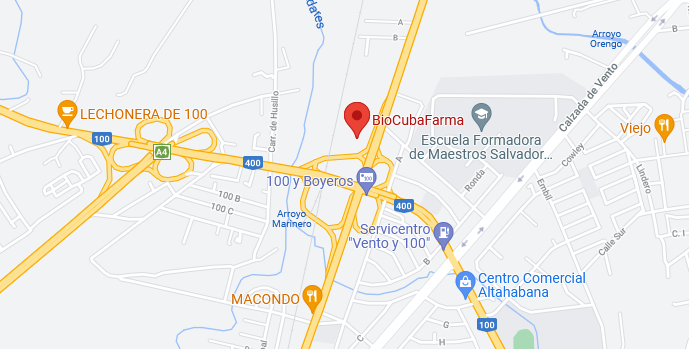
Address: Ave 26 No. 1605 e / Calzada de Boyeros y Calzada de Puentes Grandes, Plaza de la Revolución. Habana-Cuba.
Web site: www.cidem.cu
Copyright © 2023 CIDEM